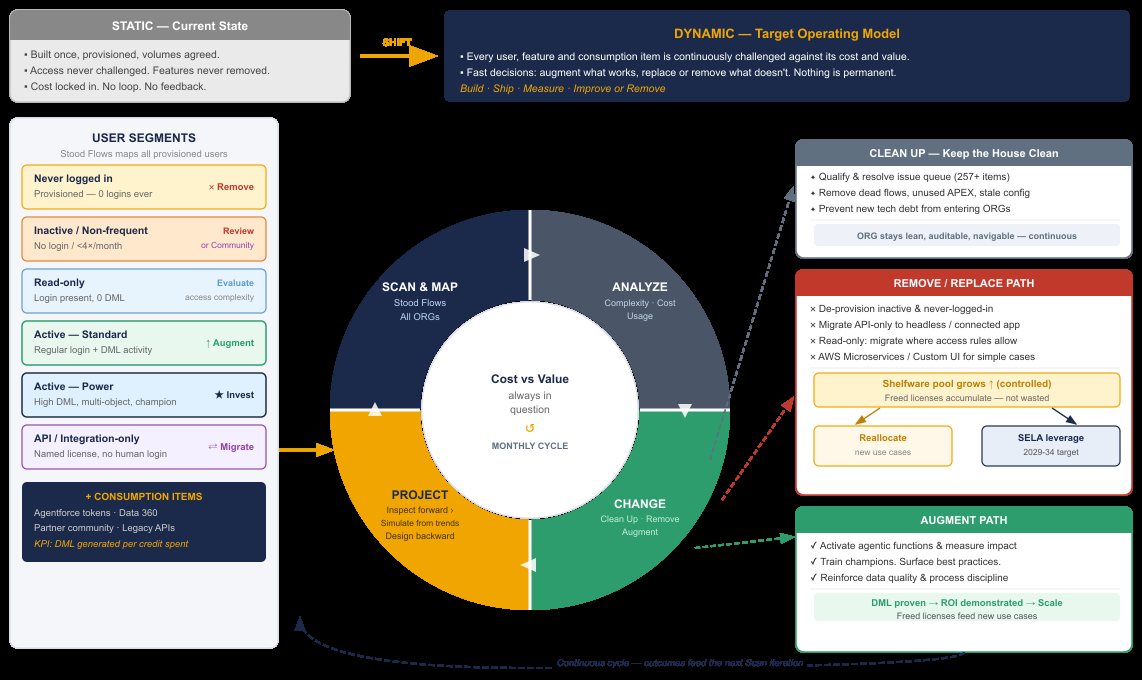
Most Salesforce professionals treat an “audit” like a dental checkup: something you do once a year, dread the results, and then promptly forget about until the next pain point arises. But in a world of rapid-fire deployments and AI-driven complexity, a static audit is a relic of the past.
It’s time to stop looking at your org as a snapshot in time and start viewing it as a continuous transformation cycle.
Introducing Stood Flows for the Salesforce Flywheel effect — a framework powered by MCP (Model Context Protocol) integration and custom analysis notebooks, designed to turn technical debt into your greatest strategic advantage.
The Problem: The “Black Box” of Silent Complexity
Every Salesforce instance eventually hits a wall. We call it “Silent Complexity” — the hidden web of overlapping flows, redundant validation rules, and “ghost” metadata that no one dares touch for fear of breaking the system.
When you can’t see the map, you can’t drive the car. Stood Flows changes that by creating a radical visualization of your metadata.
The 4-Step Flywheel of Continuous Evolution
The Stood Flows methodology isn’t just a list of tasks; it’s a self-reinforcing cycle. As the wheel spins, friction decreases and velocity increases.
1. Map the “Black Box.” Radical visualization of your entire metadata ecosystem.
2. Identify bloat and “Why.” High-fidelity views that pinpoint exactly where your org is dragging.
3. AI-driven scripts. Targeted analysis of overlapping flows and conflicting logic.
4. Prune and Simplify. Immediate savings and friction-free user experiences.
The AI Edge: MCP Integration Without the Exposure
What makes Stood Flows different is how we use AI. We aren’t just pointing a chatbot at your code; we’ve built an integration layer that prioritizes both depth and security.
Deeper Analysis via MCP
By using Model Context Protocol (MCP), we connect AI agents directly to your metadata map. These agents don’t just see code; they interpret relationships. They can reveal hidden dependencies that a human eye might miss, suggesting architectural considerations that proactively prevent future technical debt.
The Read-Only “Firewall”
Security isn’t an afterthought; it’s the architecture. Stood Flows acts as a secure firewall. AI agents analyze the metadata we compile, never touching your live Salesforce instance or sensitive customer data. You get the depth of AI analysis without pointing an agent at your production org.
“The goal isn’t just to fix what’s broken; it’s to build a system that’s easy to change.”
The “Double Effect”: Compounding ROI
The true magic happens when the cycle completes. We call this the Double Effect.
Every time you prune a redundant flow or simplify a process, you aren’t just cleaning up — you’re generating “found money.” The savings in performance, license optimization, and developer time are funneled back into the next cycle.
New budgets and resources fund the next level of transformation. The wheel spins faster, the org gets leaner, and your team moves from “keeping the lights on” to “driving the business forward.”
Spin the Wheel
The days of the “one-and-done” audit are over. Most teams start with a Quickstart, prove the value fast, then keep the wheel turning with a monthly refresh — tech debt decreases measurably over snapshots. Check out Stood Flows here.