Stood is built for Global Fortune 500 companies struggling to sustain their CRM: large Salesforce estates that have accreted for a decade, where the platform is business-critical and nobody can any longer say what all of it does. Our customers’ names are confidential and stay that way — that is a working condition of analysing an enterprise’s core systems, and we treat it as discipline, not as a gap in this page.
If you own an estate like that, you will recognise most of the following conditions. None of them is a failure of the people involved; each is what a reasonable decision looks like after it compounds for ten years.
The conditions
Multi-org by history, not by design. Mergers, regional autonomy, a business unit that bought its own org. Nobody chose this shape — and now every governance question gets answered one org at a time, in different formats, by different people, while technical debt, bloated automation and an unmeasured license buffer quietly accumulate inside every instance.
Cost inflation without a usage story. List prices rise, renewals compound, and consumption products — Agentforce tokens, Data Cloud processing — add a meter to a budget that used to be a seat count. The CRM budget now scales with every AI action and data event, and nobody can connect the invoice to work actually done. Waiting for the annual true-up to find out is not a strategy.
Accretion, never subtraction. Every quarter adds record types, layouts, profiles, flows, Apex. Nothing is ever removed, because removal has no owner and no credit: additions are visible — someone asked for them — while their accumulated weight is not. Each choice was defensible in isolation. The compound effect was not.
Knowledge that left the building. The people who built it moved on; the documentation, where it exists, describes an org that no longer exists. One day, nobody in the room can answer a simple question: where is the weight actually sitting?
Averages that hide everything. Org-wide numbers — “4 million records”, “250 profiles” — are true and useless. They average the processes that carry the whole business together with the ones that handle twelve records a year. The interesting variance lives at the business-process level, and org-wide health scores never reach it.
AI pressure on an undocumented foundation. Agentic ambitions land on a platform nobody can fully describe, so the risk is invisible until it is expensive — the agents inherit the same tangled automation and rate limits that slowed the human teams.
Governance without evidence. Architecture boards that arbitrate on opinion, because no one brings numbers. Findings that live in slide decks instead of backlogs. A renewal negotiated from the account executive’s spreadsheet.
If four or more of these read as your estate, you are who Stood Flows was built for. What follows is what the analysis looks like on an estate shaped like yours.
Meridian Hospitality Group: an estate, in detail
What follows is one portfolio described the way Stood describes it — five orgs, a contract, and six months of movement. Read it as a mirror rather than a case study: the numbers are not yours, but the shape very likely is.
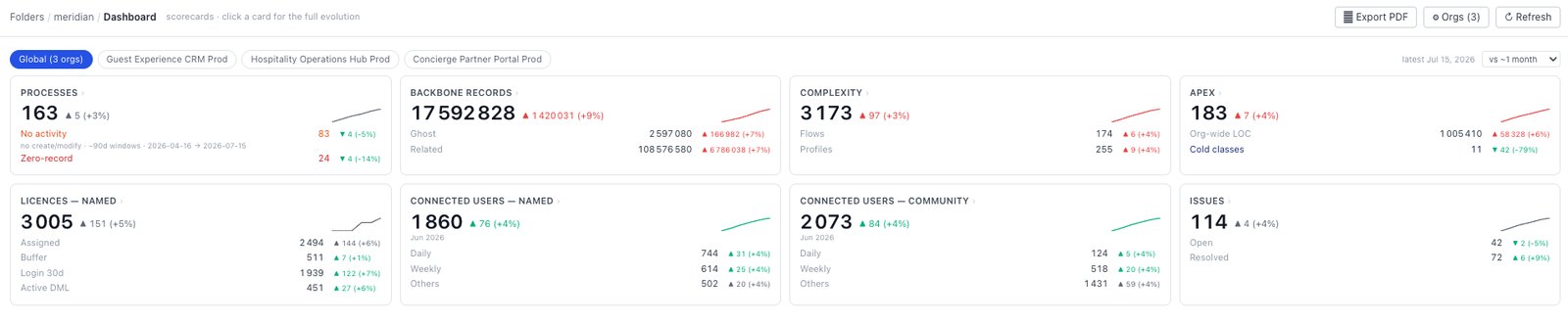
Meridian runs five production orgs: a flagship Guest Experience CRM, a large and healthy Revenue & Distribution org, an operations satellite, an Events & Catering Sales org, and a partner portal. Across the portfolio: 4,285 provisioned seats, 3,512 assigned — a buffer of 773 seats, 18% — and 254 business processes, of which 126 show no activity in the period and 47 hold no records at all. Half the structure being maintained, tested and paid for produced no measurable work.
4 of 8 scorecards shown · portfolio scope, five orgs · vs previous snapshot · illustrative.
Two orgs carry the story, in opposite directions. Events & Catering Sales holds a 56% buffer, with 19 of its 26 business processes showing no activity and 8 holding no records at all — money standing still, one business unit quietly paying for an org nobody adopted. The flagship Guest Experience CRM holds 12% — comfortable today, but thin going into a renewal, because at renewal unused entitlement is the only lever a customer holds, and a buffer near zero at the end of the term means no credible case to reduce the next commitment. Same estate, opposite problems, and neither is visible from the 18% average; a per-org scorecard makes both unmissable. Every estate we have analysed has orgs like these. The question is only which ones yours are.
Inside the flagship org, the licensing question resolves twice — once as a measurement, once as a decision. The funnel narrows from the contract down to the people who wrote to a business object; the ladder beside it qualifies what is actually actionable, rung by rung, each with its own threshold and its own remedy. The gap between the two ends of the funnel is not the opportunity. The rungs are.
Flagship org of the demonstration estate, on the provisioned scale. Login levels measured over a 30-day window; operation and business-write levels over a two-week event-log window; the 90-day rung uses the longer, safer threshold deliberately. Illustrative — synthetic estate, not customer results.
Then the contract. Meridian’s SELA (Salesforce Enterprise License Agreement) carries a catalogue value of $6.57M per year, capped at $4.21M per year, across 102 lines — and those lines map to 9 orgs, four of which are not core org estate at all: a legacy org, a Marketing Cloud MID, a Data Cloud tenant, a Heroku account. Knowing which lines do not represent your orgs is a finding worth having before anyone reconciles a single one — the gap between what the contract covers and what you can analyse with Stood is itself the first result.
| SKU | Status | Org | Qty | Rate | /yr |
|---|---|---|---|---|---|
| Customer Community Plus — Logins | ✓ mapped | Guest Experience | 88,032 | 0.28 | $295,788 |
| CRM Analytics Plus — Unlimited | ✓ mapped | Guest Experience | 420 | 50 | $252,000 |
| Customer 360 Privacy Center · 5% of net | ✓ mapped | Guest Experience | 1 | 5% | $176,682 |
| CPQ Plus — Unlimited | ✓ mapped | Revenue & Distribution | 96 | 65 | $74,880 |
4 of 102 lines shown · unit and % add-on pricing, each line mapped to the org that consumes it · illustrative.
Six months of movement — is the debt falling faster than the estate is growing?
A point-in-time audit tells you where an estate stands. Snapshots tell you which way it is going, which is the difference between a report and a practice. Meridian carries seven monthly snapshots, so every number above has a trajectory behind it — and the trajectory is the thing a programme can actually be held to.
The estate keeps accreting
Expected, and not by itself a problem. It is the denominator everything else is read against.
Bloat, and the work on it
This is the band that has to fall against a growing estate — and the backlog only means something read beside what has been closed.
Adoption — the part that should be rising
A CRM has to actionate concrete business. This is whether it does.
The buffer — a position, not a leak
It steps up on purchase dates and erodes as assignment catches up. The saw-tooth is the licensing cycle made visible, and sizing it against the contract cycle is the work — not driving it to zero.
Portfolio scope, five orgs · seven monthly snapshots, 15 Feb 2026 → 14 Aug 2026 · process activity on the ~90-day snapshot window. Deltas are against the February baseline. Illustrative — synthetic demonstration estate, not customer results.
Read it as a ratio, not a row of numbers. The estate grew: 199 business processes to 254, and the summed complexity score with them, 3,747 to 5,064 — up 35% in six months. None of that is remarkable; enterprise Salesforce accretes monotonically, and a growing business legitimately adds processes. The question a governance practice exists to answer is whether the bloat inside that growth is falling faster than the growth. On three measures here it is: dead structure down 18% against a structure that grew 28%, the open issue backlog down 25% with 118 issues closed, and processes carrying real work up from 45 to 128. Zero-record processes humped to 74 before falling back to 47 — a launch cycle, not a crisis, and a single reading would have called it the opposite.
Where it cuts the other way, it says so. Complexity is still climbing, and climbing faster than dead processes are being retired. That is the honest reading of this estate: the practice is working on what it has been pointed at, and accretion elsewhere has not stopped. A programme claiming simplification while that line rises is visible in one glance — which is the whole reason to keep a baseline instead of writing a report.
The buffer is the one line that is not a verdict. It steps up on purchase dates and erodes as assignment catches up, and that saw-tooth is the licensing cycle made visible. A buffer sized deliberately against the contract cycle is defensible at renewal in a way that a single percentage never is; a buffer driven to zero is a negotiating position given away.
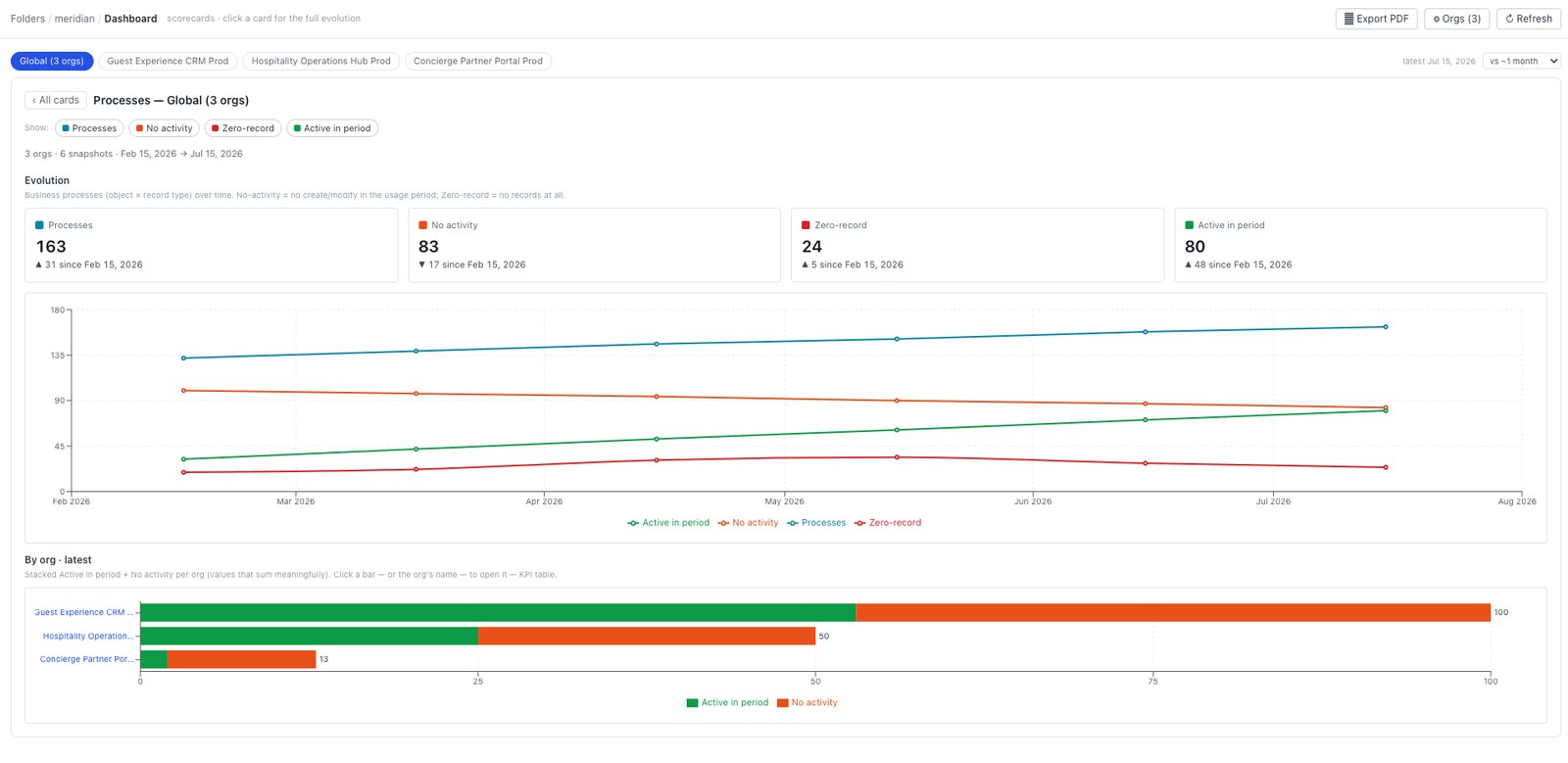
None of this is visible in a point-in-time audit. All of it is visible against a baseline. Progress becomes a number, not an opinion.
Read your own estate against this
Three questions you can ask today, before any tool is involved.
- How many business processes — object × record type — does your estate carry, and how many were active this quarter? Most leadership teams estimate a few dozen. On any estate older than five years the real count runs far higher, and the gap between the two numbers is the most revealing figure in the exercise.
- Which of your orgs is your Events & Catering Sales? Every multi-org estate has one that sits far below the rest on seats, activity and adoption. If you cannot name yours, that is the finding.
- What fraction of your contract maps to estate you can actually analyse — and who could produce that mapping, line by line, before the next renewal?
If any of those took more than a minute to answer, a Quickstart — a couple of hours with one of our experts — will show you what the analysis surfaces. The first scoped project that follows answers all three on your own orgs, against a published method your architects can audit.
Meridian Hospitality Group is a synthetic demonstration estate. All figures on this page are illustrative — not customer results or benchmarks.