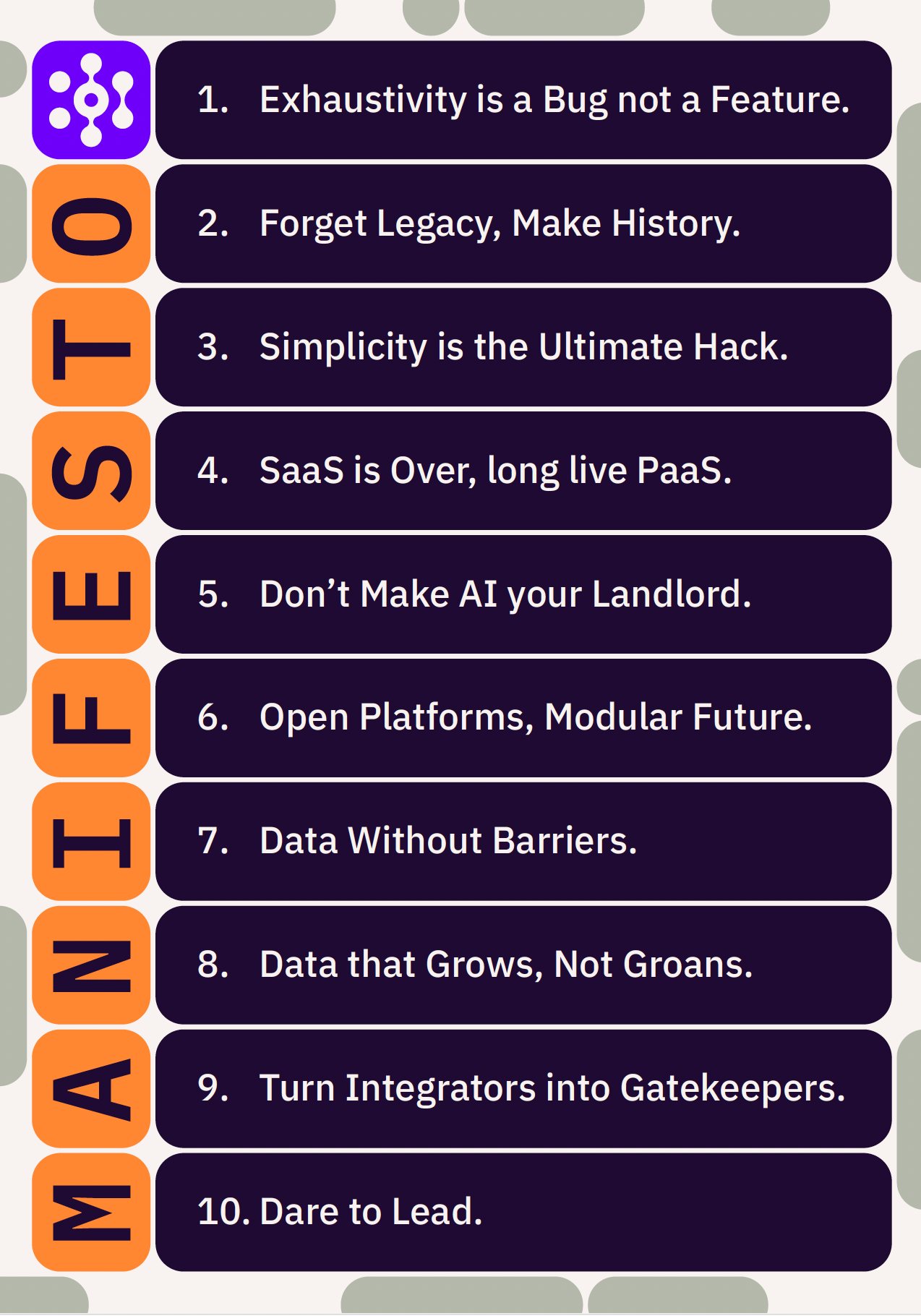
We’re challenging the status quo in enterprise CRM with our Simplicity as a Service manifesto. The enterprise software game is broken: clunky, overpriced, and stuck in the 00s. Complexity is sold as capability, bloat is billed as value, and the people who own these systems are asked to trust scores they cannot check.
We hold to a shorter creed. We make CRM simpler. We remove bloat with sharp insights and tooled methods.
The principles
1. Complexity is the enemy. Not the platform, not the vendor, not the team — the accumulated weight of a thousand reasonable decisions nobody ever went back to count. Cost is a symptom. Bloat is the disease.
2. The business process is the unit. Not the org, not the metadata component. One object, one record type, one lived business reality — the level at which weight has an owner and a budget, and at which an audit becomes an action.
3. Measure, don’t rate. Every business process is sliced and structured from a defined set of metadata that we extract, count and sum. Every item is individually verifiable against the org. A score you can audit is a measurement; anything else is an opinion.
4. nothing is sent to Stood — the analysis is local by default, and team sharing runs on your own GitHub or S3. The analysis runs where you are — no cloud backend, no connected app, read-only. Sovereignty over your own system knowledge is not a feature tier.
5. Don’t make AI your landlord. Own your intelligence stack. Plug in the models you choose, and hold every AI action answerable to the value it produced and the credits it consumed.
6. Removal is a feature. If it is easy to add, it must be easy to remove. The cheapest component is the deleted one, and a schema is healthy only while someone is subtracting from it.
7. Simplicity is a practice, not a project. A one-shot cleanup decays. Measured monthly, technical debt goes down snapshot after snapshot — and stays down.
What we promise
Sharp insights: numbers with denominators, verifiable line by line. Tooled methods: the same analysis your architect uses to plan a refactor, run as a monthly control. Simpler CRM: fewer processes, fewer profiles, fewer cold classes, a contract that matches reality.
That’s the service. Simplicity is what it delivers.