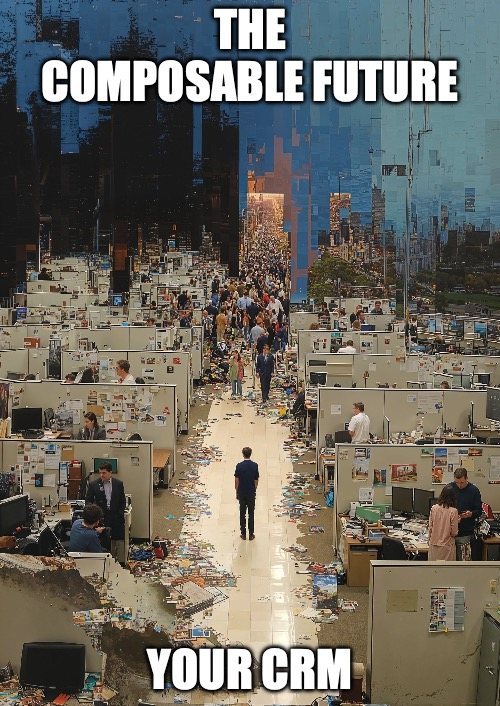
Introduction: The CRM Straightjacket
Is your CRM working for you, or are you working for your CRM?
For decades, the promise of a Customer Relationship Management (CRM) system was a single source of truth — a centralized platform to manage every customer interaction. This led to the rise of the monolithic CRM: massive, all-in-one software suites that tried to be everything to everyone.
The problem? They ended up being a “one-size-fits-none” arrangement.
Businesses today are dynamic, data-driven, and desperate for an edge. They’re finding that their rigid, monolithic CRMs are no longer an asset but a bottleneck. They are a “walled garden” in an open, interconnected world.
It’s time to stop forcing your unique business processes into a rigid box. It’s time to start composing.
The Monolithic Wall: Pain Points of the Past
The monolithic CRM is built on an outdated philosophy. It assumes one vendor knows your business better than you do. This leads to a cascade of familiar frustrations for any modern business:
- Data is Trapped: Your customer data, the lifeblood of your company, is locked inside the CRM’s proprietary database. Getting it to your data warehouse for real analysis is a painful, often batch-driven process. Getting insights back into the CRM? Even harder.
- Innovation at a Snail’s Pace: Want to use the latest GenAI tools? You have to wait for your CRM vendor to build (or acquire) and integrate it, often as part of an expensive new module. You’re tethered to their roadmap, not your own.
- Rigid Workflows: Your sales process is unique. Your marketing automation has specific needs. Monolithic systems force you into their way of doing things, and customization is either impossible, astronomically expensive, or creates a “Frankenstein” system that breaks with every update.
- Bloated and Expensive: You’re paying for a massive suite of tools, but you probably only use 30% of them. Yet, to get the one new feature you need, you’re forced to upgrade to a higher, more expensive tier, bundling in even more features you don’t want.
There is a fourth frustration, quieter than the others, that makes the first three permanent: nobody can see the whole thing anymore. After years of customization, the monolith is not just rigid — it is illegible. And an illegible system cannot be simplified, because every removal feels like defusing a bomb.
Composition Is an Architecture — and a Discipline
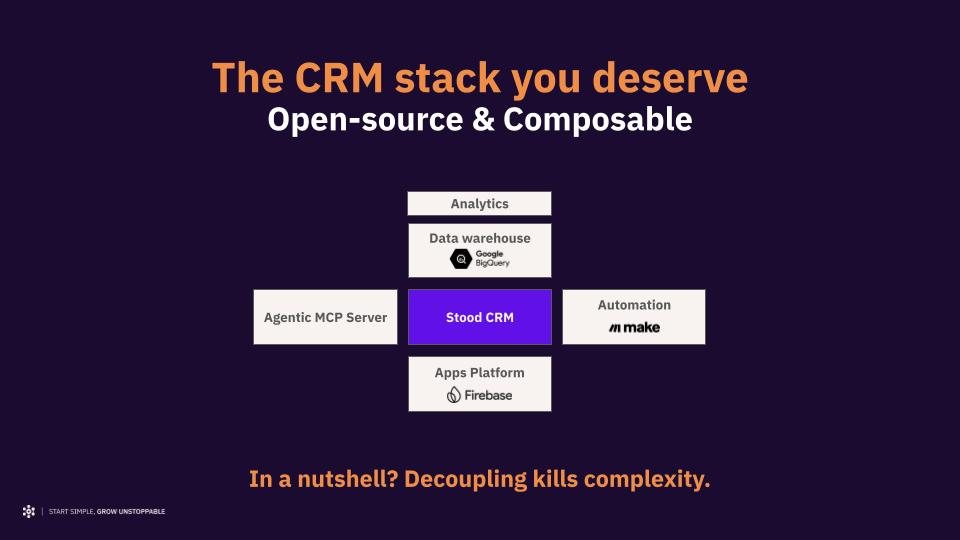
A composable approach is a modular, open ecosystem where each layer does the job it is actually good at:
- A Lean Operational Core: The CRM itself should carry the backbone processes — the workflows your teams operate every day — and nothing else. Lean, well-documented, stable. For most enterprises that core is Salesforce, and it should stay there. Composing is not migrating; it is right-sizing.
- Centralized, Scalable Data: Your analytical truth doesn’t live in the CRM. It lives in your data warehouse (Snowflake, BigQuery, Redshift) — your company’s single source of truth for analysis, reporting and AI. Reporting fields, duplicated dashboards and “just in case” copies come out of the CRM and into the layer built for them.
- The Information Superhighway (Reverse ETL): Enriched, accurate data pipes from your warehouse back into the tools your teams use. Your marketing team doesn’t just see a contact; they see a contact enriched with product usage data, support ticket status, and a predictive churn score.
- Extensibility on Your Terms (AI, APIs, Custom Builds): In a composable world, you’re not waiting for a vendor. You plug in the AI models and services you choose. And the custom complexity that never belonged in the platform — the local exceptions, the bolted-on modules — can be absorbed by shared-source components deployed on your own cloud, where you own the schema and the pipeline.
But the architecture is the second step. The first is the discipline the monolith never imposed: you cannot compose what you cannot count. Before anything moves, measure what the CRM is actually carrying — per business process, one object and one record type at a time. Which processes are alive, which are archives pretending to be processes, what each one costs in complexity and licenses. That measurement is what turns “composable” from a buzzword into a sequence: what stays in the core, what moves to the warehouse, what gets rebuilt, and — most often forgotten — what simply gets deleted.
Why Composable Isn’t Just a Buzzword — It’s a Strategy
- Ultimate Flexibility: Build the exact system your business needs. Add or swap components as you scale. You are finally in control of your own tech stack.
- Future-Proof Your Business: The next big thing after GenAI is coming. With a composable system, you’ll be able to integrate it in days, not years, while your competitors are still waiting on their monolithic vendor.
- Data-First, Not App-First: By putting your data warehouse at the center, you break down data silos. Your CRM, marketing platform, and finance tools all work from the same set of facts.
- Lower Total Cost of Ownership: Stop paying for bundled features you don’t use — and stop maintaining configuration nobody uses. The cheapest component is the one you removed.
Conclusion: Measure First, Then Compose
The era of the one-size-fits-all CRM is over. The monolithic block is a relic of a time when data was simple, and businesses were forced to adapt to software.
The future is composable. But composition starts with a map, not a migration. This is the work Stood does: we make CRM simpler by removing bloat with sharp insights and tooled methods — measuring every business process so that what stays, stays for a reason, and what goes, goes safely.
Tired of fighting your CRM? See how Stood Flows maps what yours is actually carrying, or book an assessment.