Ask an architecture board how many business processes their estate runs and you will get an estimate, usually a low one. Count them and the number is different, and so is the conversation that follows.
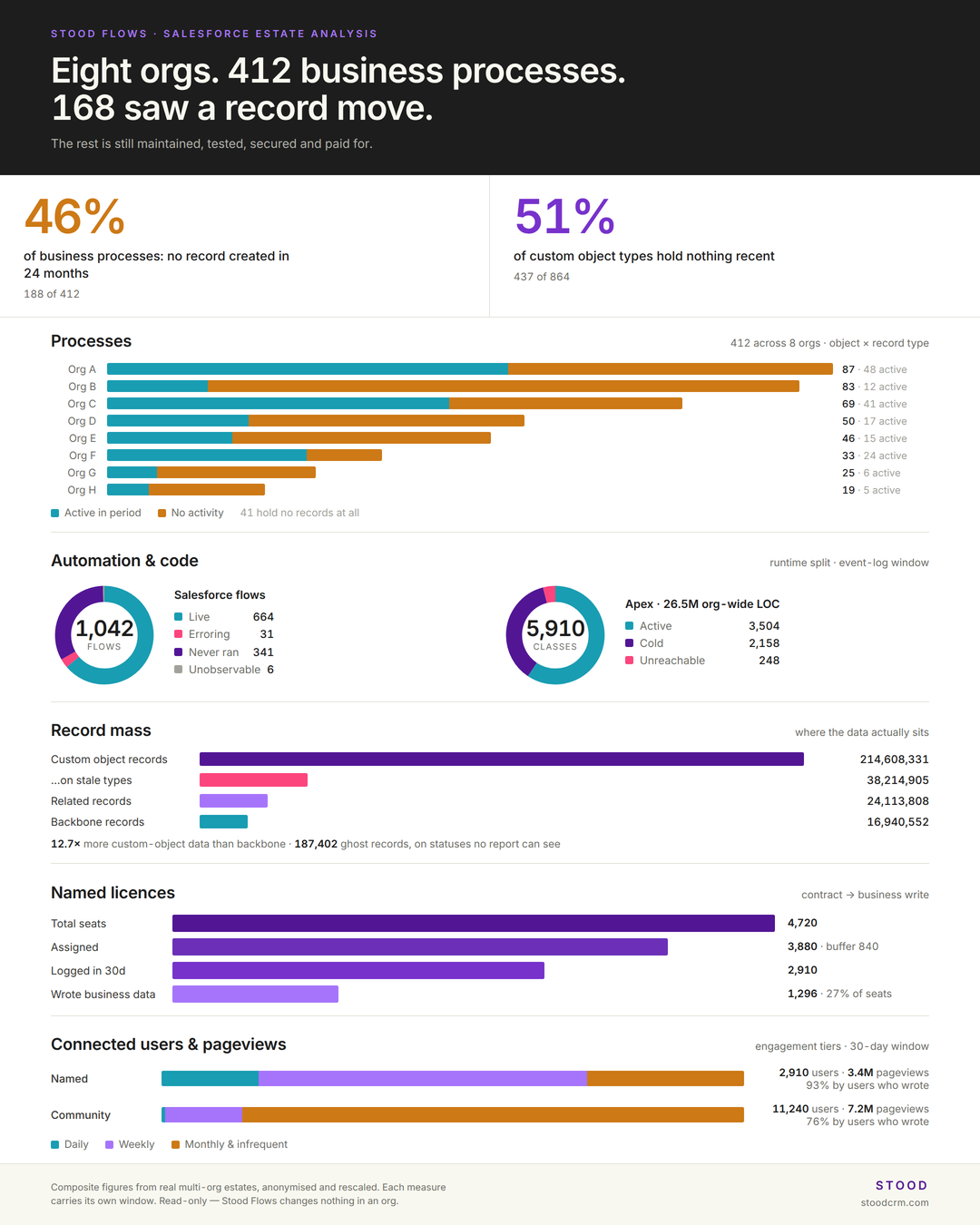
Here is one estate, counted. Eight orgs, 412 business processes — one object combined with one record type. In the usage window, 168 of them saw a record created or modified. The other 244 were maintained, tested, security-reviewed and licensed anyway.
Figures below are composites from real multi-org estates, anonymised and rescaled. The shape is what travels, not the digits.
The average hides both ends
No estate is uniformly idle, which is why an org-wide health score never reaches the finding. In this one, the largest org works 48 of its 87 business processes. The second largest works 12 of 83. Same estate, same year, opposite problems — and neither is visible from the portfolio total.
The other end of that distribution is emptier still: 41 business processes hold no records at all. Fully built — stages, profiles, layouts, automation — and never used. A cancelled launch, a regional variant for a market that never opened, a migration staging type. Each one still carries its full structural weight into the complexity score, and each remains a swimlane every new architect has to read past.
Automation and code that nothing reaches
Of 1,042 flows, 341 never appeared in the observed window while other flows on the same objects ran. 31 were erroring. Four could not be watched at all, so they are not counted as cold — silence that cannot be measured is not evidence.
Apex tells the same story with a harder edge. 5,910 classes, of which 2,406 showed no execution in the window. 248 of those are unreachable: no entry point reaches them at all. That last figure is the one that needs no event-log window. A longer audit can clear a cold class; it can never clear an unreachable one.
The mass is not where anyone looks
The backbone — the objects the business is actually run on — holds 16.9 million records. The custom object estate around it holds 214.6 million, better than twelve to one, and 38.2 million of those sit on object types nothing has written to in two years. That is the storage bill, the backup window and the sandbox copy, growing quietly because insert-only objects never generate a complaint.
From the contract down to a write
4,720 named seats. 3,880 assigned, leaving a buffer of 840. 2,910 logged in over 30 days. 1,296 wrote business data — 27% of what the contract provides.
The buffer is not waste queued for deletion; at renewal, unused entitlement is the only lever a customer holds. The number worth arguing about is the one below it, and arguing about it requires having measured it.
None of this is a verdict
Every figure here is a candidate for review. A quiet process may be seasonal; a cold class may be a load-bearing dispatcher that happened not to fire; an empty record type may be next quarter’s launch. Stood Flows surfaces the insight with its window printed on it. An analyst qualifies it against business value, technical constraint and job weight, and raises what survives as an issue. Nothing in the tool writes to an org.
The estate above took an afternoon to measure. Most teams have never seen their own version of it.
Stood Flows measures a Salesforce estate by business process — structure, real usage and contract cost — read-only, with no Stood cloud in the data path. A Quickstart is a couple of hours with one of our experts, showing what the analysis surfaces on an org you own.