Stood Flows · Marketing Cloud add-on · 1.3.2

The same folder, now with the business units that send the email

A Marketing Cloud business unit sits next to the Salesforce orgs it feeds. It is refreshed in the same background run, read through one retrieve-only path, and answers the question the CRM side cannot: what does the reach actually cost.

Folder · Salesforce orgs and Marketing Cloud business units togetherSTOOD
Customer folder one dashboard · one backlog · one refresh all Guest Experience CRMsalesforce org Revenue & Distributionsalesforce org Operations Hubsalesforce org Meridian Brand MIDmarketing cloud · parent BU Luxury Collection BUmarketing cloud City Hotels BUmarketing cloud Marketing Cloud Connect ties the CRM to the BUs; the folder shows both sides and the campaign-member bottleneck between them. refresh all · background · pause and resume One retrieve path server-to-server OAuth, GET only secrets in OS keychain, never in UI name-validated · no write Cost & reachcontacts reached vs licence Data Extensionsorigin → readers map Issuessame backlog as the orgs Integrationsparent BU only
Shipped in 1.3.2: MC business units as graphs, encrypted credentials, retrieve-only IPC, four views per BU, folder-level MC dashboard, connection diagnostics. Illustrative estate.

Cost and reach

The first view puts three numbers side by side: contacts the licence pays for, contacts in Contact Builder, and contacts actually reached by a send in the last 90 days. The gap between the first and the third is the same shape as unassigned CRM seats: paid capacity that moves nothing. Send volumes by campaign and month come from the send jobs, so the trend is visible before anyone asks for a report.

Cost & reach · Luxury Collection BU · 90 daysSTOOD
Licensed contactscontract line · super messages aside 2,400,000 In Contact Builderall contacts, any source 1,902,400 Reached in 90 daysat least one send delivered 610,118 25% of what the licence pays for Consumption is cadence-based until a tracking scope exists on the account; the view says which it is.
Illustrative — Meridian Hospitality Group. Bars share one scale.

Data Extensions: who writes it, who reads it

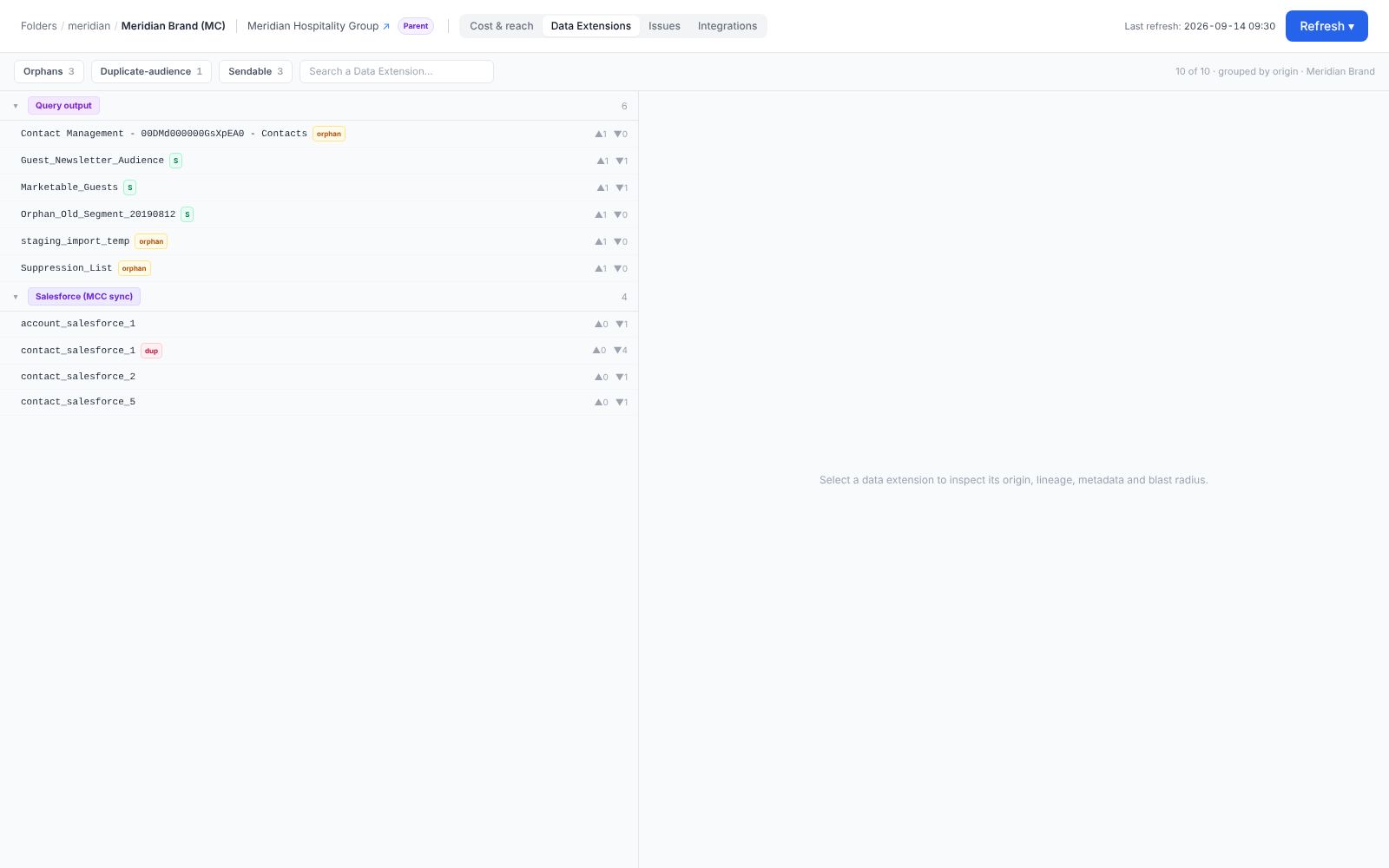
Every data extension is placed on a map from its origin (a Connect sync, an import, a query, an API push) to the journeys, automations and queries that read it. Two shapes matter: an extension nobody reads, kept in sync at every cycle, and two extensions holding the same audience under different names. Both cost contact rows and both are invisible from inside Marketing Cloud's own folders.

Shipped

Issues on the same backlog

A stale data extension or an empty send definition files as an issue next to a zero-record record type. One epic tree per customer, across CRM and marketing.

Shipped

Integrations, parent BU

Installed packages, API users and their last activity, read at the parent. The usual find: a package permission set that even sysadmins lack, which hides every Connect field from SOQL on the CRM side.

What this means on Monday. Add the parent MID to the folder with a server-to-server package that has read scopes only. One refresh later the reach gap is a number on the dashboard, next to the seat gap.

What is known not to work yet

Anything that only the SOAP API exposes (data extension listing in some packages, lists, audiences, automatic business-unit discovery) depends on the package the customer grants, and the connection diagnostics say so by name. Super messages are read from the contract, not from Marketing Cloud. Send-level tracking needs a tracking scope; until then consumption is derived from cadence.

In the app

Captured from the application itself, built from the current source tree and opened read-only on the Meridian demonstration workspace.
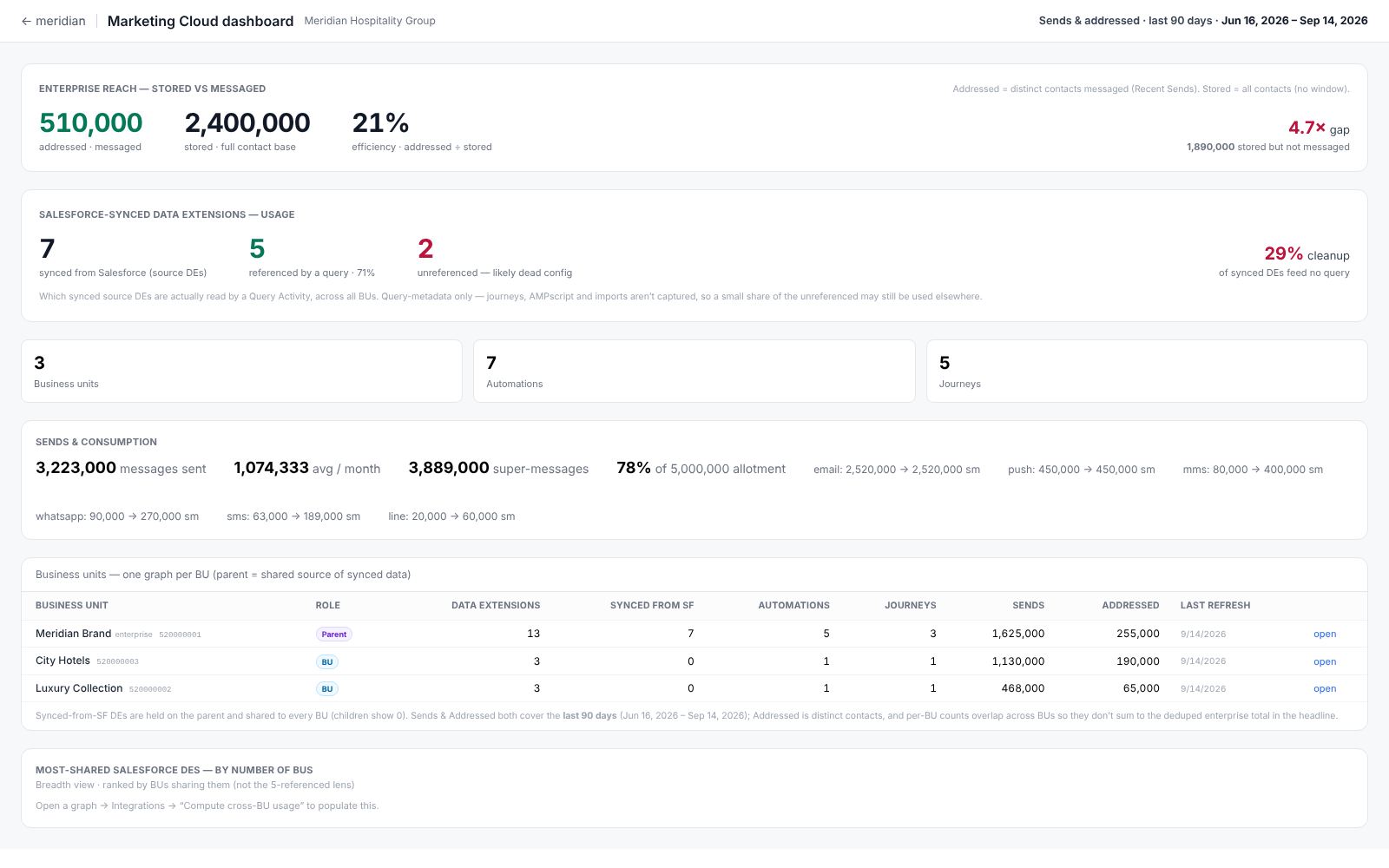
The folder-level Marketing Cloud dashboard: enterprise reach (addressed versus stored), synced data extensions and their usage, sends and consumption, one row per business unit.
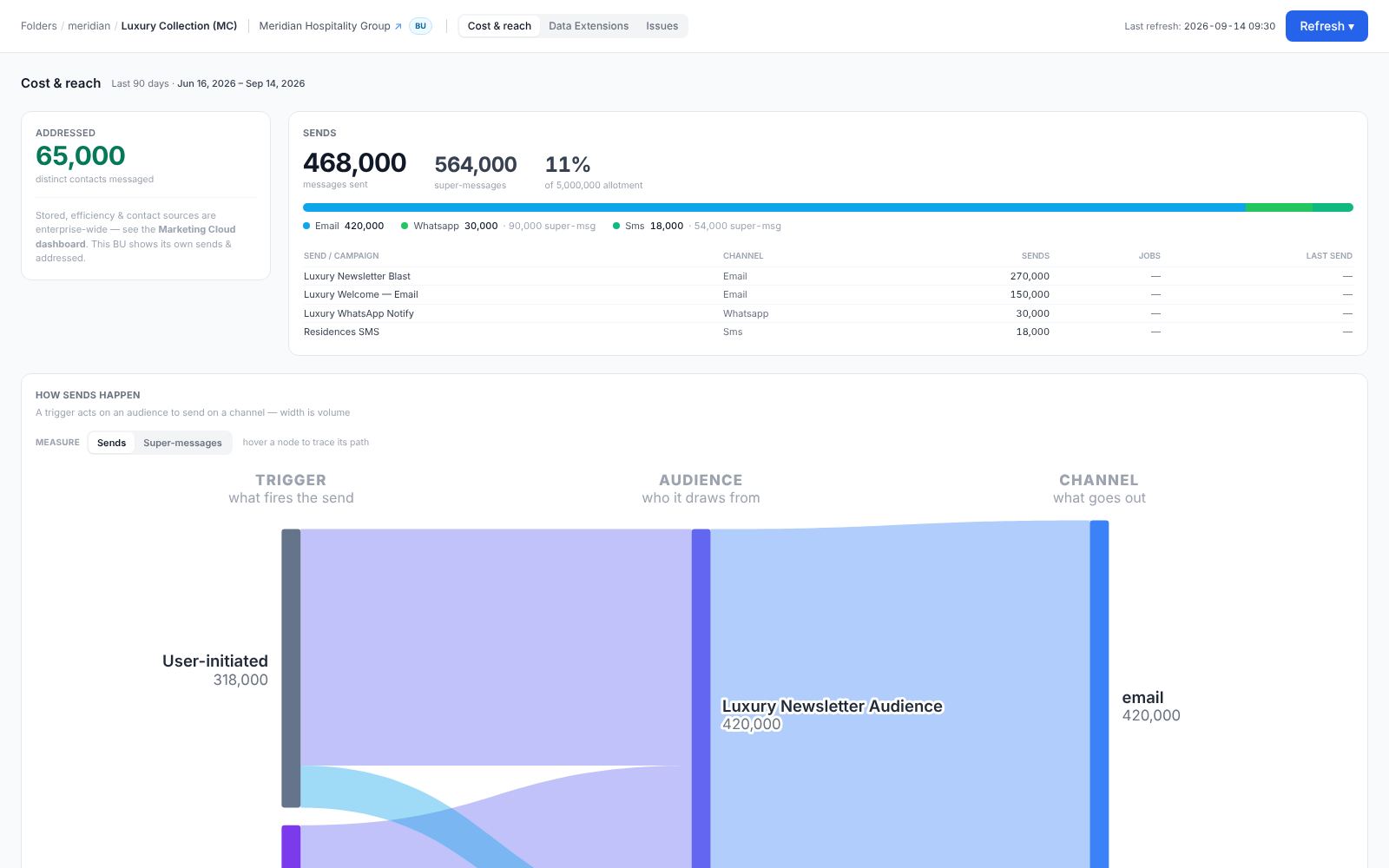
Cost & reach of one business unit: addressed contacts, sends by channel against the super-message allotment, and the trigger → audience → channel flow of every send.
Data Extensions, grouped by origin: query output, Salesforce sync, orphans and duplicate audiences flagged.