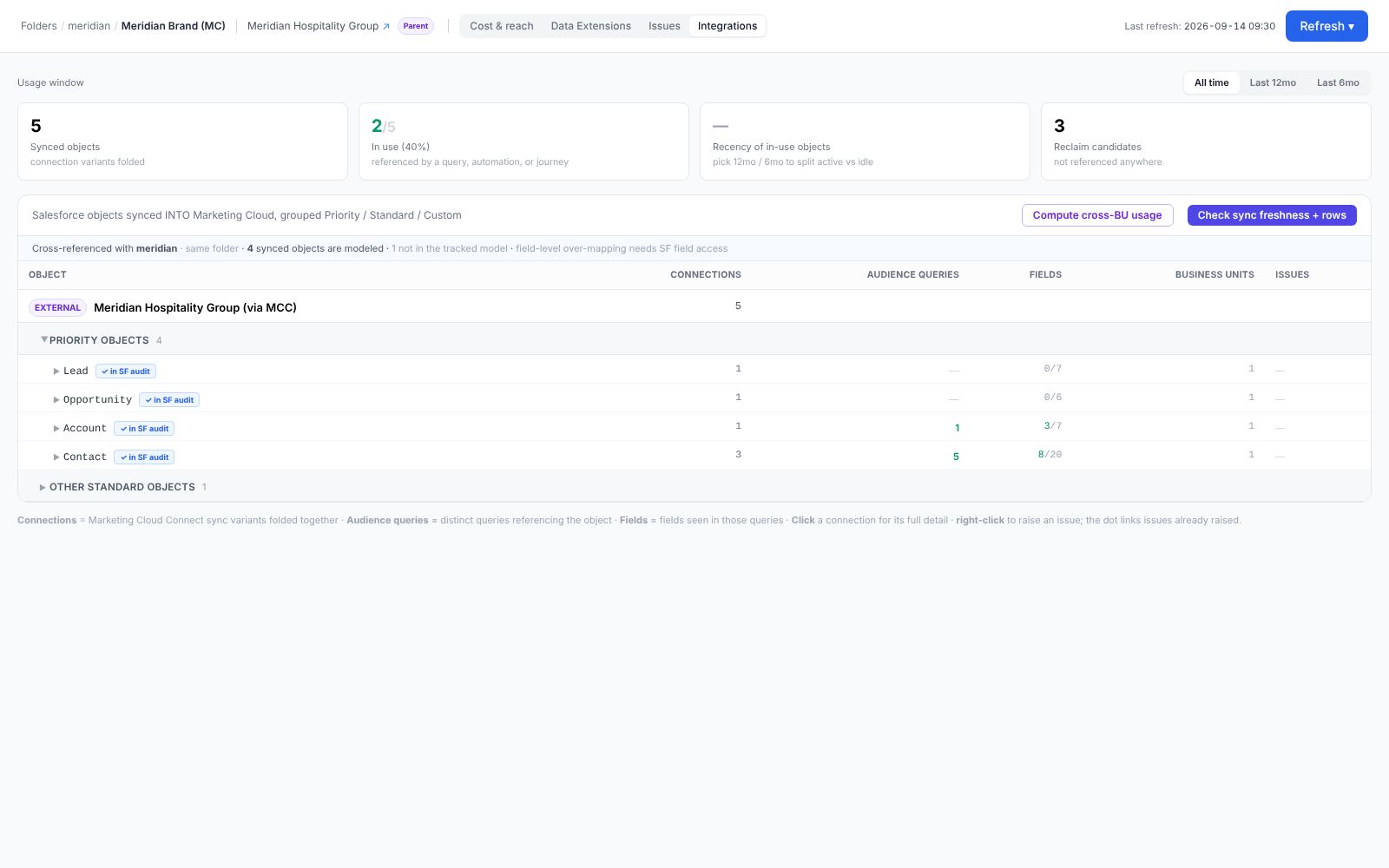
An account synced to Salesforce accumulates data extensions that mirror Salesforce objects. Over time most of them stop being used by anything. The Integrations view shows what’s synced in, where it came from, and whether anyone is actually referencing it.
Synced data extensions and their Salesforce sources
A synced data extension is one fed by the Salesforce connector — its name ends in the connector’s _Salesforce suffix. Each is grouped under the Salesforce source it mirrors, with the org it syncs from named rather than left as an opaque identifier. Contact-management model extensions and filtered views are excluded, because neither is a synced source table.
Tables versus objects
Two counts describe the same sync at different grains, and they’re meant to:
- Tables — every synced data extension, counted individually.
- Objects — the distinct Salesforce objects behind them, with connector variants of the same object folded together.
One object can land as several tables. Counting objects tells you how many distinct Salesforce sources feed the account; counting tables tells you how much the sync sprawled.
Source-DE usage is an indirect cost
A synced data extension nobody references isn’t a licence cost — it doesn’t add to your send or super-message consumption. What it adds is maintenance burden and clutter: every unused extension is one more row in the audience picker a marketer has to scroll past, and one more thing to reason about when the sync changes. Treat this view as a cleanup lens, not a money slide. The usage story is “how much of this sync is dead,” and most of it usually is.
Cross-BU usage
Cross-BU usage ranks shared data extensions by how many business units reference each one — a breadth lens. A top-of-list extension used by many BUs is a shared dependency worth knowing about before anyone changes it. This is distinct from the count of extensions referenced at all: breadth is “how widely,” reference is “whether at all.”
Integrations is an enterprise-level view. It appears on the parent, not on individual business units, because the sync is an account-wide concern.